
Amazon Holiday Products Trends 2027: Sales Forecast, Product Opportunities and SEO Strategy for Sellers
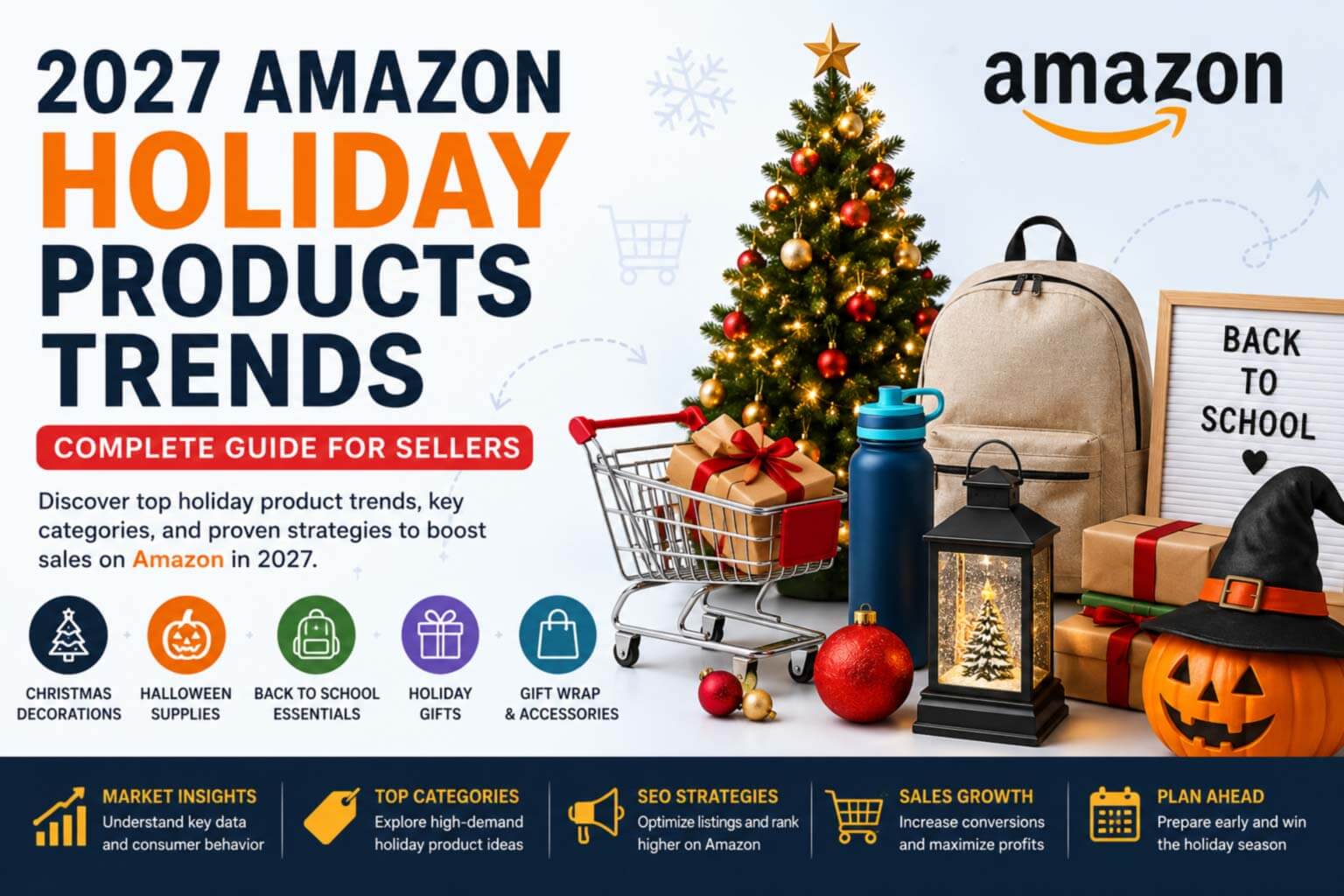
Amazon Holiday Products Trends 2027
Holiday and seasonal products remain one of the most attractive opportunity areas on Amazon U.S. Unlike daily consumables, which rely on steady repeat demand, or electronics, which depend heavily on technical upgrades, holiday products are driven by seasonal intent, shopping events, emotional demand, gift-giving behavior and delivery speed.
1. Why Holiday Products Remain a High-Potential Amazon Category
Holiday products are a classic example of seasonal demand-driven ecommerce. Consumers buy around predictable annual events such as Valentine’s Day, Easter, Mother’s Day, Father’s Day, back-to-school season, Halloween, Black Friday, Cyber Monday and Christmas.
For Amazon sellers, this category has three major advantages:
- Clear demand windows: Major U.S. holidays create recurring search and purchase demand every year.
- High-intent keywords: Shoppers often search directly for terms such as “Halloween decorations,” “Christmas tree,” “back to school supplies” and “Mother’s Day gifts.”
- Flexible pricing structure: Sellers can combine low-priced traffic drivers, mid-priced revenue products and high-priced profit products.
If you are planning seasonal product research, you can combine this guide with our internal resources:
Amazon product research guide and Amazon keyword research guide.
2. 2026 Amazon Holiday Product Sales Structure: Christmas, Back-to-School and Halloween Lead the Market
2.1 Christmas and Winter Holiday Products: The Largest Seasonal Category
Christmas decorations, Christmas trees, string lights, wrapping paper, greeting cards, stocking stuffers, table decorations and outdoor displays form the largest holiday product segment on Amazon U.S. In the 2026 baseline estimate, Christmas decorations, trees, lights and packaging products generated approximately US$5.42 billion in sales, accounting for about 38.2% of total holiday product sales.
The strength of this category comes from its wide product coverage. Consumers do not only buy Christmas trees; they also buy lights, wreaths, table decorations, outdoor inflatables, gift bags, wrapping paper, greeting cards and small gifts. As a result, the Christmas season is not driven by one single product, but by multiple subcategories expanding at the same time.
External data also supports this pattern. According to Jungle Scout Amazon holiday decor trends research, Christmas trees, inflatable decorations and wreaths show strong seasonal growth on Amazon during the holiday shopping period.
2.2 Back-to-School Supplies and Backpacks: A Strong July–August Demand Driver
Back-to-school season is one of the most important shopping periods in the second half of the year. In the 2026 baseline estimate, back-to-school supplies and backpacks reached approximately 124 million units and US$2.72 billion in sales, representing around 19.2% of total holiday and seasonal product sales.
This segment benefits from strong necessity, concentrated family purchasing and frequent replenishment. Typical products include notebooks, folders, pencil cases, lunch boxes, storage bags, school backpacks and branded backpacks.
According to NRF back-to-school consumer research,many U.S. consumers begin shopping for school supplies in early July or even earlier. This means sellers should not wait until August to launch listings. Product listings, advertising tests and FBA inventory planning should ideally be completed by late June or early July.
For more planning ideas, read: Amazon back-to-school product strategy.
2.3 Halloween Decorations and Costumes: A High-Intent September–October Category
Halloween products have a strong emotional and visual shopping appeal on Amazon. Consumers are not only buying functional items; they are buying seasonal atmosphere, family experiences and social display.
In the 2026 baseline estimate, Halloween decorations, costumes and props reached approximately 84 million units and US$1.82 billion in sales. Typical products include outdoor inflatable ghosts, pumpkin lights, spider decorations, Halloween costumes, party tableware, trick-or-treat bags, backdrop decorations and wall decor.
However, Halloween costumes and large decorations often carry higher return risk. Size issues, product-image mismatch, cheap-looking materials and inflatable product defects can all hurt ratings and conversion rates. Sellers should strengthen size charts, material descriptions, lifestyle images, installation guides and product videos before the peak season.
You may also read: Amazon Halloween product selection checklist.
3. Price Band Analysis: Low-Priced Products Drive Traffic, Mid-Priced Products Drive Revenue, High-Priced Products Drive Profit
The pricing structure of holiday products can be summarized in one sentence: low-priced products generate traffic, mid-priced products generate revenue, and high-priced products generate profit.
3.1 Low Price Band: Under US$15
Low-priced products include greeting cards, small decorations, Easter basket fillers, basic stationery, stickers, balloons and party tableware. These products usually generate high order volume but limited unit profit. They work best as traffic drivers, add-on items or bundle components.
The main risk of this price band is margin pressure. Advertising costs can quickly erode profit, so low-priced products should usually be connected to bundles, multipacks or a wider product matrix.
3.2 Mid Price Band: US$15–US$50
The mid-price band is the revenue center for most Amazon holiday products. Gift sets, medium-sized decorations, standard backpacks, Halloween costumes, table displays and lighting sets are commonly found in this range.
These products are affordable enough for seasonal impulse purchases while still offering sellers a reasonable margin. For many sellers, this is the most important price range to build around.
3.3 High Price Band: Above US$50
High-priced products contribute a smaller share of unit sales but a much larger share of GMV and profit. Typical examples include branded backpacks, medium and large Christmas trees, outdoor inflatable decorations, premium gift sets and high-end lighting products.
For high-priced products, the key is not aggressive discounting but trust-building. Sellers should optimize main image quality, product videos, A+ Content, installation instructions, size comparison images, customer reviews and return-risk management.
According to the Northwestern Spiegel research on how online reviews influence sales, online reviews have a meaningful effect on purchase decisions, especially for higher-priced products.
4. 2027 Second-Half Trend Forecast: Earlier, Longer and More Distributed Peak Seasons
Looking ahead to the second half of 2027, Amazon holiday product sales are expected to continue growing, but the growth pattern will change. In the past, many sellers treated Black Friday, Cyber Monday and Christmas as the only major peak. Going forward, the holiday season will start earlier and become more distributed across July to December.
4.1 July–August: Back-to-School Demand Starts Earlier
July will become a key window for back-to-school warm-up and Prime Day traffic capture. Sellers should prepare keywords such as “school supplies,” “backpack,” “lunch box,” “pencil case” and “classroom supplies.”
August remains the main peak for school supplies, backpacks, lunch boxes, storage products and dorm-related items.
4.2 September–October: Halloween and Christmas Preheating Overlap
September is the launch window for Halloween products and the early testing period for Christmas products. Some consumers begin searching for terms such as “Halloween outdoor decorations,” “Halloween inflatables” and “Christmas decorations” before October.
October is a critical month where Prime Big Deal Days, Halloween demand and early Christmas shopping overlap. Amazon has also positioned Prime Big Deal Days as an event that helps customers start holiday shopping earlier. See Amazon Prime Big Deal Days official announcement.
4.3 November–December: Black Friday, Cyber Monday and Last-Minute Christmas Demand
November remains the major promotional peak for Black Friday, Cyber Monday and multi-category deals. December continues to benefit from same-day and next-day delivery, especially for last-minute gifts, decorations and gift packaging.
According to the Adobe holiday shopping report, Cyber Week remains one of the most important online shopping periods in the U.S. For sellers, this means the 2027 holiday strategy should not rely only on Black Friday. Inventory, pricing, advertising and keyword planning should be stretched across July to December.
5. Six Key Factors Affecting Amazon Holiday Product Sales
5.1 Total Holiday Consumer Demand
Holiday product sales first depend on whether U.S. consumers are willing to spend on seasonal atmosphere, gifts and family occasions. Consumer surveys around Valentine’s Day, Easter, Mother’s Day, Father’s Day, back-to-school and winter holidays continue to show resilient demand.
5.2 Earlier Promotion Timing
Prime Day, Prime Big Deal Days, Black Friday and Cyber Monday are reshaping the holiday shopping calendar. Consumers compare prices, save products and place orders earlier than before.
Sellers should prepare listings, coupons, FBA inventory, advertising campaigns and review-building plans before the main demand spike arrives.
5.3 Delivery Promise
Holiday products are highly time-sensitive. If a product cannot arrive before the holiday, conversion rates can drop sharply. According to the Amazon official news center, Amazon continues to improve same-day and next-day delivery capabilities, which can amplify last-minute holiday purchasing behavior.
5.4 Ratings and Reviews
Many holiday products are visually driven. Consumers rely heavily on review photos, real user feedback and star ratings. A new listing with no reviews may struggle to convert, even with a lower price.
5.5 Return Risk
Halloween costumes, Christmas trees, outdoor inflatables and gift sets may face higher return risk. Common causes include size mismatch, color difference, material disappointment, damaged packaging and difficult installation.
5.6 Sustainability and Reusability
Another important 2027 trend is sustainability. Reusable fabric decorations, foldable storage designs, kraft paper packaging, recycled paper gift bags and post-holiday reusable designs are likely to appeal to both price-sensitive and environmentally aware shoppers.
6. Amazon Holiday Product SEO Strategy
6.1 Use Titles That Combine Holiday Keywords and Use-Case Keywords
A strong Amazon title should not simply stuff keywords. It should combine the holiday, product type, feature, use case and target scenario.
Example title:
Halloween Outdoor Decorations, 6FT Inflatable Ghost with LED Lights, Waterproof Yard Decor for Halloween Party Lawn Garden
This title includes the holiday keyword, product keyword, feature keyword and scenario keyword, making it more relevant for both Amazon search matching and shopper click intent.
6.2 Bullet Points Should Highlight Purchase Reasons
Bullet points should answer the buyer’s most important questions: Is it suitable for the holiday scene? Is the size clear? Is it easy to install? Can it be reused? Is it giftable? Are all accessories included? Can it be used immediately?
6.3 Images Should Reduce Expectation Gaps
Many returns in holiday categories come from expectation gaps. Sellers should prepare a white-background main image, lifestyle images, size charts, accessory images, installation steps, packaging photos, festive scene images and real-use visuals.
6.4 A+ Content Should Build Brand Trust
A+ Content is especially important for mid- and high-priced seasonal products. Sellers can include comparison tables, use cases, material explanations, holiday matching ideas, storage methods, FAQ modules and brand story sections.
6.5 Advertising Should Start Earlier
Advertising should not begin one week before the holiday. Back-to-school campaigns should start testing in late June. Halloween campaigns should begin in late August. Christmas listings should start testing long-tail keywords in September, capture Prime Big Deal Days traffic in October and scale during November and December.
For more advertising tactics, read:
Amazon PPC advertising guide.
7. Seasonal Product Categories to Watch in 2027
7.1 Christmas Trees and Christmas Lights
Christmas trees, mini trees, tabletop trees, string lights, wreaths and outdoor decorations remain core opportunities. High-priced products require stronger review quality, packaging and delivery reliability.
7.2 Halloween Outdoor Inflatables
Outdoor inflatable decorations have strong visual appeal and higher average order value, but sellers must manage product quality, installation clarity and return risk carefully.
7.3 Back-to-School Storage and Backpacks
Backpacks, lunch boxes, folders, notebooks, dorm storage and school organization products are well-suited for early planning and bundle strategies.
7.4 Gift Packaging and Greeting Cards
Wrapping paper, gift bags, ribbons, greeting cards and gift tags are low-priced, high-frequency products that can work as traffic drivers or bundle components.
7.5 Reusable Holiday Decorations
Foldable, storable and reusable decorations are likely to fit the 2027 trend toward value-for-money and sustainability.
8. FAQ: Amazon Holiday Products
Q1: Are Amazon holiday products still worth selling in 2027?
Yes. Holiday products remain an important seasonal category on Amazon U.S., especially Christmas products, back-to-school supplies, Halloween products and gift packaging. However, sellers need earlier planning, better inventory control and more refined listing optimization.
Q2: Which Amazon holiday product category has the largest sales potential?
Christmas and winter holiday products usually have the largest overall sales potential, including Christmas trees, lights, wrapping paper, greeting cards, wreaths, stocking stuffers and outdoor decorations.
Q3: Should new sellers start with high-priced Christmas trees?
Not usually. High-priced Christmas trees require strong supply chain control, packaging quality, delivery reliability, reviews and after-sales support. New sellers may be better off starting with lower- or mid-priced decorations, gift packaging, tabletop decor or bundles.
Q4: When should Halloween products be listed on Amazon?
Halloween products should ideally be listed by late August. Sellers can begin testing ads and keywords in September, while October is the main sales peak.
Q5: When should sellers prepare back-to-school products?
Back-to-school products should be prepared by late June or early July. July and August are the core sales months for backpacks, lunch boxes, stationery and storage products.
Q6: How can sellers reduce return rates for holiday products?
The key is reducing expectation gaps. Sellers should provide clear size charts, real lifestyle images, material descriptions, installation steps, packaging photos and usage notes. Costume products should include accurate size guides.
Q7: Are holiday products suitable for brand building?
Yes. Although many holiday products look similar, sellers can build differentiation through design style, bundle structure, eco-friendly materials, packaging experience and scenario-based content.
Q8: What are the most important Amazon SEO keywords for holiday products?
Important keywords vary by holiday. Common core terms include Halloween decorations, Christmas decorations, Christmas tree, back to school supplies, Valentine’s Day gifts, Easter basket fillers and Mother’s Day gifts. Sellers should combine holiday keywords, product keywords, scenario keywords and audience keywords.
9. Conclusion: The 2027 Amazon Holiday Product Competition Will Be Earlier, Smarter and More Operational
The biggest change in Amazon holiday products is not simply that consumers will buy more. The real shift is that shoppers will make decisions earlier, compare prices more carefully, expect faster delivery and rely more heavily on trustworthy reviews.
The best-performing products in 2027 will not necessarily be the cheapest. They will be products that launch early, target the right keywords, use a clear pricing structure, offer reliable delivery, build credible reviews, reduce expectation gaps through better images and include reusable or sustainable value.
For Amazon sellers, holiday products are still worth pursuing. But the strategy must shift from short-term “seasonal hit product” thinking to year-round seasonal calendar management. Sellers who prepare early for back-to-school, Halloween, Black Friday, Cyber Monday and Christmas will have a stronger chance of capturing profitable growth in 2027.
References
- Amazon 2026 Q1 10-Q report
- Amazon 2025 annual report
- NRF holiday and retail consumer research
- Adobe holiday shopping report
- U.S. Census retail ecommerce data
- Jungle Scout Amazon holiday decor trends research
- Helium 10 Q4 Amazon seller benchmark report
- Northwestern Spiegel research on online reviews and sales
- Amazon Prime Big Deal Days official announcement
- Amazon official news center