
Christmas Water Lantern Quality Control: A Guide for Wholesale Buyers
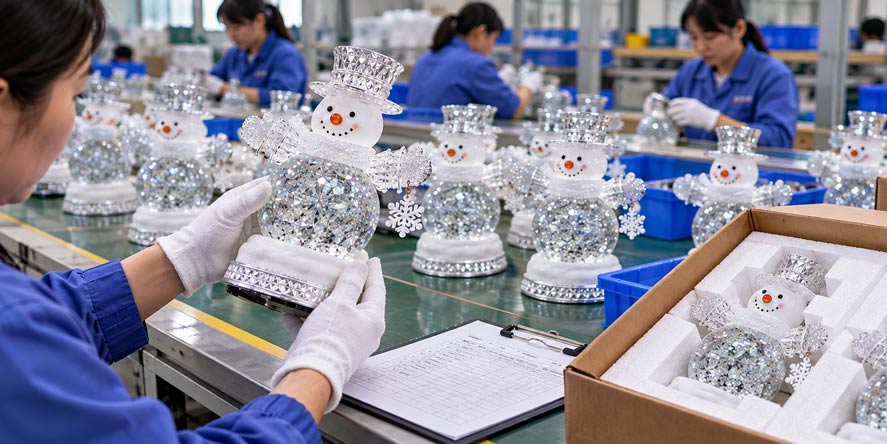
Christmas water lantern quality control inspection
Christmas water lanterns combine decorative craftsmanship with electrical components, liquid-filled chambers, lighting systems, and moving glitter effects. For international retailers, importers, and private-label brands, these features create attractive seasonal products but also introduce quality control requirements that differ from those of ordinary Christmas decorations.
A beautiful sample is not enough to guarantee a successful wholesale order. Buyers also need to consider water chamber sealing, glitter circulation, LED performance, material consistency, electrical safety, protective packaging, and transportation conditions.
This guide explains the key quality control checkpoints for wholesale Christmas water lanterns, LED glitter water spinners, and musical snow globes. It also provides practical inspection questions that purchasing teams can use when evaluating manufacturers and preparing seasonal orders.
Why Quality Control Matters for Christmas Water Lanterns
Unlike conventional resin figurines or static holiday ornaments, water lanterns may contain liquid, decorative glitter, motors, LEDs, switches, batteries, and other electrical components within a single product.
These systems must function together reliably. A problem with one component can affect the overall appearance or operation of the finished decoration.
For example, an improperly sealed chamber may leak during storage or transportation. An inconsistent glitter circulation mechanism may create uneven movement. Poorly fitted decorative parts may become damaged during handling, while unsuitable packaging can expose delicate structures to shipping impacts.
For wholesale buyers, effective quality control helps reduce the risk of customer complaints, damaged shipments, product returns, and seasonal inventory losses.
1. Water Chamber Sealing and Leak Inspection
The liquid-filled chamber is one of the most important components of a Christmas water lantern. Its sealing system should be designed to maintain the intended liquid level throughout normal handling, storage, and use.
Leakage can affect the decorative appearance, damage packaging, and potentially create additional hazards when liquid reaches electrical components.
What Should Buyers Inspect?
- Visible leakage or moisture around the chamber and its joints.
- Unexpected changes in liquid level.
- Damage, deformation, or irregularities around sealing areas.
- Loose connections between the chamber and surrounding structure.
- Evidence of leakage after appropriate handling and transportation testing.
Manufacturers should establish sealing specifications and inspection procedures appropriate to the chamber material, structure, and assembly method.
Where relevant, buyers can request documentation describing the manufacturer’s leak inspection process and the acceptance criteria used during production.
2. Glitter Circulation and Water Spinner Performance
Automatic glitter circulation is a defining feature of many LED Christmas water lanterns and shaped water spinners. When operating correctly, the internal mechanism creates continuous or programmed movement that enhances the decorative scene.
However, the appearance of the glitter effect can vary depending on the chamber shape, internal components, glitter characteristics, and operating mechanism.
Key Performance Checks
- Does the glitter circulate consistently during the intended operating cycle?
- Are there unusual interruptions or unexpected mechanical noises?
- Does the movement match the approved product sample?
- Are the decorative figures positioned correctly?
- Does the mechanism operate correctly under the specified power supply?
- Does the product restart normally after being switched off?
Buyers should evaluate glitter circulation under realistic lighting conditions. Some glitter colors and chamber designs may appear different when the product is illuminated compared with when it is switched off.
For unusual shapes, such as snowmen, Christmas trees, or hot cocoa cups, circulation performance should be evaluated for the specific chamber geometry rather than assumed to match a conventional round snow globe.
3. Water Clarity and Internal Appearance
Clear liquid and a well-presented internal scene contribute significantly to the visual quality of a water lantern. Cloudiness, unwanted particles, visible residue, or inconsistent liquid levels can reduce the perceived quality of the product.
During inspection, buyers should compare finished units with an approved reference sample under consistent lighting.
Visual Inspection Points
- Liquid clarity and overall appearance.
- Unwanted particles or visible contamination.
- Consistency of glitter color and quantity.
- Alignment of internal figurines and decorative elements.
- Appearance of the chamber surface.
- Consistency of the approved liquid level.
Manufacturers should define acceptable visual tolerances before mass production. Minor characteristics that are acceptable for one decorative style may not be appropriate for another.
4. LED Lighting Quality and Electrical Performance
LED illumination plays an important role in the appearance of Christmas water lanterns. Lighting can highlight glitter movement, create depth within winter scenes, and enhance translucent decorative materials.
Depending on the design, a product may include warm white LEDs, cool white LEDs, multicolor lighting, or programmed illumination effects.
Quality inspections should verify that the lighting matches the approved product specification.
Recommended LED Inspection Items
- Correct LED color and intended brightness.
- Consistent illumination without unexpected flickering.
- Reliable operation of switches and controls.
- Correct operation under the specified power supply.
- Appropriate wiring and component assembly.
- Absence of abnormal heating during specified operating tests.
- Correct operation of available timer functions.
Where products use batteries, adapters, or USB power, buyers should confirm the applicable electrical specifications, included accessories, labeling, and safety requirements for the destination market.
Electrical safety testing should be based on the actual product design and applicable regulations, not on a generic assumption that all LED Christmas decorations require identical certifications.
5. Music, Rotation, and Additional Functions
Some premium Christmas water lanterns include music, rotating figures, or multiple operating modes. These additional functions can enhance the product experience but also increase the number of components that require inspection.
For musical models, buyers should confirm that the correct melodies are installed, playback is consistent, and the sound system operates as intended.
Where independent music and lighting controls are provided, inspectors should verify each operating mode separately.
For products with rotating elements, inspection should cover the movement of the decorative components, the stability of the mechanism, and any unusual vibration or noise.
Each function should be tested against the approved specifications for that particular model.
6. Quality Control for Shaped Christmas Water Spinners
Shaped Christmas water spinners introduce design considerations beyond those of traditional lanterns. Their exterior structures may include decorative arms, hats, handles, branches, stars, and other protruding elements.
These details can create distinctive seasonal products, but they also require careful attention during manufacturing, assembly, inspection, and packaging.
Snowman Water Spinners
Snowman-shaped products may include sculpted hats, scarves, arms, and decorative accessories surrounding a glitter-filled body. Inspectors should evaluate the attachment strength, surface finish, alignment, and overall stability of the completed figure.
Christmas Tree Water Spinners
Crystal-inspired Christmas tree designs may feature textured translucent surfaces, metallic bases, and decorative ornaments. Buyers should check for visible surface defects, consistent lighting distribution, stable assembly, and secure decorative components.
Hot Cocoa Cup Water Spinners
Novelty cocoa cup designs may incorporate handles, decorative whipped cream, candy canes, and saucers. These structures should be inspected for secure assembly, surface consistency, and resistance to damage during ordinary handling.
For more examples of specialty product structures, explore our guide to Shaped Christmas Water Spinners Wholesale.
7. Decorative Finish and Assembly Consistency
Christmas water lanterns often combine several decorative materials and finishes. Depending on the model, these may include resin components, transparent chambers, metallic coatings, painted details, and textured surfaces.
Finished products should be compared against an approved reference sample for color, decorative appearance, assembly alignment, and workmanship.
Important inspection points include paint consistency, visible scratches, loose accessories, uneven decorative finishes, and unwanted gaps between assembled components.
For products featuring metallic silver or gold finishes, buyers should agree on acceptable color variation and surface appearance before production begins.
8. Protective Packaging and Transportation Testing
Packaging is especially important for liquid-filled decorative products because damage may occur during warehouse handling, container loading, distribution, or parcel delivery.
Protective packaging should support the product’s weight, shape, and vulnerable components while limiting unwanted movement inside the carton.
Possible packaging solutions include molded protective inserts, foam supports, inner cartons, retail boxes, and suitable outer shipping cartons.
Packaging Evaluation Checklist
- Does the protective insert support the product securely?
- Are protruding accessories protected from pressure and impact?
- Is the product prevented from moving excessively inside the package?
- Does the outer carton meet the intended distribution requirements?
- Are handling labels and product identification accurate?
- Has the complete packaging configuration been evaluated under an appropriate transportation test?
Testing requirements should reflect the actual distribution environment. Packaging designed for palletized wholesale shipments may not be sufficient for individual e-commerce parcel delivery.
Buyers may use recognized distribution-testing frameworks, such as applicable ISTA testing procedures, when developing a packaging validation plan.
9. Pre-Production Sample Approval
Before placing a substantial wholesale order, buyers should review representative samples and agree on the product’s technical and visual requirements.
A documented sample approval process helps establish expectations for both the manufacturer and purchasing team.
The approved sample should be supported by written specifications covering dimensions, materials, decorative finishes, electrical functions, glitter effects, packaging, labeling, and applicable compliance requirements.
When a product includes customized shapes, new tooling, or additional electrical functions, further engineering validation may be necessary before mass production.
10. In-Process Quality Control During Manufacturing
Quality control should not be limited to the final inspection stage. Identifying problems during manufacturing can reduce the number of defective units reaching final assembly.
Depending on the production process, useful checkpoints may include incoming component inspection, decorative finishing inspection, chamber assembly checks, electrical component verification, and functional testing.
Manufacturers should maintain inspection records appropriate to the product and the requirements agreed upon with the buyer.
For private-label projects, clear communication between product development, production, and quality teams is particularly important when specifications change after sample approval.
11. Final Random Inspection Before Shipment
Final random inspection allows buyers to evaluate a sample of finished goods before shipment. It should be conducted against agreed specifications and a documented inspection plan.
Buyers may use sampling approaches based on recognized standards, such as ISO 2859-1, when suitable for their product and commercial agreement.
Inspection criteria should define what constitutes a critical, major, or minor defect, along with the relevant acceptance limits.
The inspection should cover product appearance, operation, labeling, accessories, packaging, and any other requirements specified in the purchase agreement.
A random inspection does not guarantee that every product in a shipment is defect-free. It provides a structured method for assessing a production lot based on the agreed sampling plan.
12. Compliance and Documentation for International Buyers
Different markets may impose different requirements on electrical decorations, battery-operated products, materials, packaging, and product labeling.
Importers should identify applicable requirements for the intended destination market before confirming product specifications and production.
For example, relevant requirements may differ between the United States, European Union, United Kingdom, and other retail destinations.
Buyers should request product-specific test reports and compliance documents where required. A manufacturer’s general certification or factory audit does not automatically establish compliance for every finished product.
For European market requirements, buyers can consult the European Union’s official CE marking guidance. Applicability must be determined for the actual product.
13. Questions to Ask a Christmas Water Lantern Manufacturer
Before selecting a wholesale supplier, purchasing teams should ask practical questions about the manufacturer’s quality management procedures and product development capabilities.
- How are water chambers inspected for leakage?
- What checks are performed on glitter circulation mechanisms?
- How are LED lighting and other electrical functions tested?
- How is consistency maintained between approved samples and production units?
- What procedures apply to unusual or custom-shaped products?
- How are protective packaging configurations evaluated?
- Can the manufacturer provide inspection records and applicable test documentation?
- What is the procedure for handling defects or nonconforming products?
- Can third-party inspections be arranged when required?
- How are changes to product specifications controlled?
The answers can help buyers compare suppliers based on documented processes rather than price alone.
14. OEM and ODM Quality Planning for Custom Christmas Water Lanterns
Custom Christmas water lanterns may involve new decorative shapes, internal scenes, colors, electrical functions, packaging, or branded components.
Each modification can affect manufacturing requirements and should be evaluated before mass production.
For example, changing the shape of a water chamber may require additional assessment of sealing and glitter movement. Adding a decorative handle or extended accessory may affect product stability and packaging protection.
SYL Crafts supports OEM and ODM development for seasonal decoration collections, including LED water lanterns, shaped water spinners, and related Christmas products.
Learn more about our Seasonal Product Development and OEM/ODM Services.
15. A Wholesale Buyer’s Christmas Water Lantern Inspection Checklist
| Inspection Area | What to Verify |
|---|---|
| Water Chamber | Sealing, clarity, liquid level, visible defects |
| Glitter Mechanism | Consistent circulation and normal operation |
| LED System | Lighting color, brightness, controls, power operation |
| Music and Rotation | Correct operation where included |
| Decorative Finish | Color consistency, workmanship, assembly alignment |
| Product Structure | Stability and secure attachment of accessories |
| Packaging | Protective fit, carton quality, transport suitability |
| Labeling | Accurate instructions, product details, required warnings |
| Documentation | Approved specifications and applicable test records |
This checklist can serve as a starting point for wholesale procurement discussions. Final inspection requirements should be tailored to the actual product, destination market, and purchase agreement.
Why Choose SYL Crafts for Christmas Water Lantern Development?
SYL Crafts is a China-based seasonal decoration manufacturer serving international retailers, wholesalers, importers, distributors, and private-label brands.
Our product categories include LED Christmas water lanterns, glitter water spinners, musical snow globes, resin decorations, and other seasonal home décor products.
We support B2B customers with product development, sampling, customization, production coordination, and discussions about quality requirements for their seasonal collections.
Whether you are sourcing classic Christmas water lanterns or developing distinctive shaped water spinners, clear specifications and agreed inspection criteria are essential to a successful wholesale program.
Explore our Water Lanterns and Snow Globes Wholesale Collection to learn more about available product styles.
Frequently Asked Questions About Christmas Water Lantern Quality Control
How are Christmas water lanterns checked for leaks?
Leak inspection methods depend on the chamber structure and manufacturing process. Buyers should confirm that the manufacturer uses appropriate sealing checks and agreed acceptance criteria, including evaluation after relevant handling or transportation tests.
What causes glitter circulation problems in water spinners?
Potential causes may include issues with the circulation mechanism, internal obstructions, unsuitable component assembly, or power supply problems. The exact cause should be determined through inspection and testing of the affected model.
Do all LED Christmas water lanterns need the same safety certifications?
No. Applicable safety and regulatory requirements depend on product design, electrical configuration, materials, intended use, and destination market. Buyers should confirm the requirements for each product rather than relying on a generic certification list.
Why is packaging testing important for water lanterns?
Water lanterns may contain liquid-filled chambers and delicate decorative components. Appropriate packaging evaluation helps determine whether the packed product can withstand the expected distribution and handling conditions.
Can buyers arrange third-party inspections for wholesale orders?
Third-party inspections may be arranged when agreed with the supplier. Buyers should define the inspection scope, sampling plan, defect classifications, and reporting requirements before inspection takes place.
Are shaped Christmas water spinners more difficult to inspect?
Unusual shapes may introduce additional inspection points, such as protruding accessories, structural stability, chamber geometry, and protective packaging. Inspection plans should account for the specific design rather than assuming every model has identical requirements.
What should buyers approve before mass production?
Buyers should approve representative samples and documented specifications covering product appearance, materials, functions, dimensions, packaging, labeling, and applicable testing requirements.
Develop Reliable Christmas Water Lantern Collections with SYL Crafts
Effective Christmas water lantern quality control begins with clear product specifications and continues through sample approval, manufacturing, inspection, and packaging validation.
For wholesale buyers, these steps help establish consistent expectations and reduce avoidable risks when sourcing seasonal decorative products.
SYL Crafts works with international B2B customers on Christmas water lanterns, shaped water spinners, and custom seasonal decoration development.
Explore Products: Wholesale Water Lanterns and Snow Globes
OEM/ODM Development: Custom Seasonal Decoration Manufacturing
Contact SYL Crafts: Visit Our Website to discuss your product requirements and wholesale sourcing plans.