
How to Build a Christmas Ornament Assortment for Gift Shops
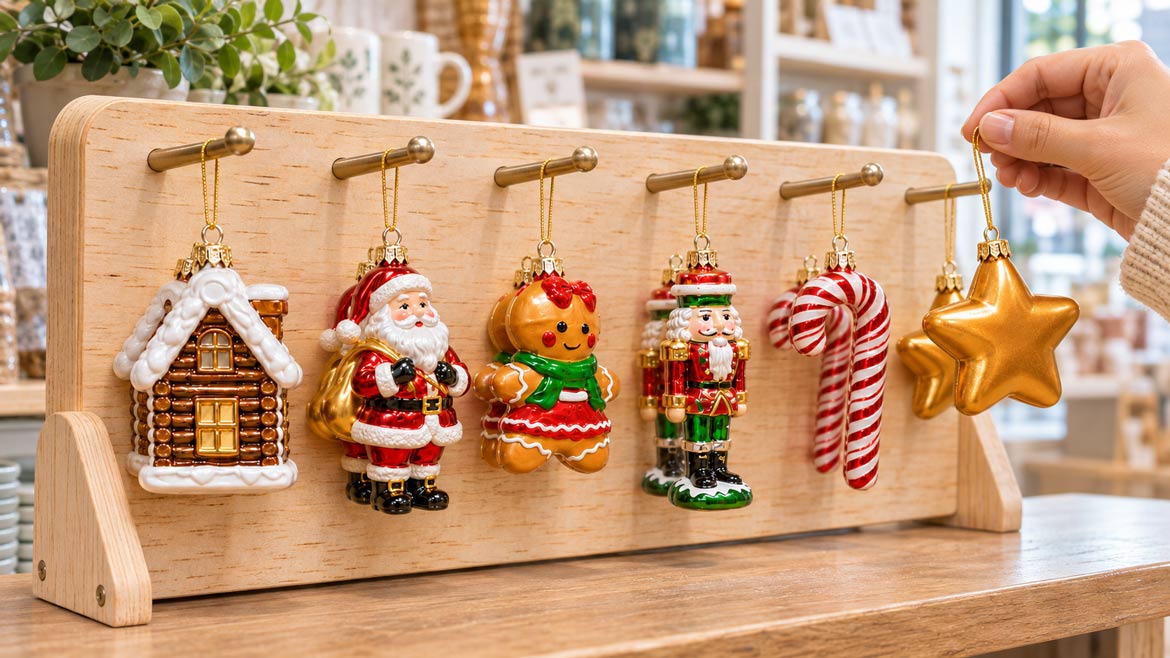
A shopper lifts a gold star ornament from a wooden countertop rack displaying six glass Christmas ornament designs.
A gift shop sells the last Santa ornament on Saturday morning. Six gold stars are still hanging beside the empty hook. The buyer wants more Santas, but the supplier sells them only in a mixed case. Reordering would bring in another six stars as well. That is an expensive detail to discover halfway through December.
When comparing wholesale Christmas ornament assortments, ask for three things together: a photo of every design, the number of pieces per design, and the reorder options. Then work backward from your display space and target retail prices. Here is how to turn a shortlist of ornaments into an opening order your store can sell and replenish.
Start With the Display Space You Actually Have
Count how many different ornaments a customer can see from the front of the fixture. A rail with six usable hooks gives you six visible positions. Hanging several pieces behind each sample adds stock, but the shopper still sees only six designs. Buying twelve styles for that rail means choosing which six will spend opening week in the stockroom.
Shape matters as much as hook count. A wide glass cabin can overlap the ornament beside it, while a long candy cane may touch the shelf below. Ask for the width of the widest design and the total hanging length of the longest, including its cord. On a checkout display, try lifting the middle ornament off its hook with one hand. If it knocks against the glass on either side, allow more space or reduce the number of designs.
Choose a Mix Shoppers Can Recognize at a Glance
For a traditional Christmas display, start with familiar shapes and give each one a reason to be there. In the assortment shown on the cover, Santa and the nutcracker share a red-and-gold palette, but their silhouettes are easy to tell apart. The striped candy cane and gold star offer simpler choices, while the snow-covered cabin gives shoppers a keepsake with a small scene to discover.
| Design | Role in the assortment | What to check on the sample |
|---|---|---|
| Santa Claus | A familiar gift choice that anchors the collection | Does Santa face forward when suspended from the actual hanging cord? |
| Nutcracker | A traditional figure with a tall, narrow profile | Is the face and uniform detail visible from the aisle? |
| Gingerbread figure | A playful option for a baking or family holiday theme | Can shoppers distinguish the icing details at display distance? |
| Candy cane and gold star | Two simple shapes that coordinate with different tree themes | Does the cane hang clear of the shelf, and does the star have enough side clearance? |
| Snow-covered cabin | A detailed keepsake for a shopper choosing one special ornament | Can the shopper see the snowy roof and front door without turning the piece? |
Use your own store history to decide which of these roles deserves the most space. A mountain gift shop might give cabins two hooks. A shop beside a theater might do the same for nutcrackers. When shortlisting samples, review the available materials, shapes, finishes, and customization options in the SYL Crafts wholesale Christmas ornament guide.
Set Retail Price Points Before Approving the Mix
Write a target shelf price beside each design. A simple star might occupy the entry price point, a painted Santa the middle, and a detailed cabin the keepsake tier. Treat those positions as a buying plan until the supplier quotes the pieces. A hollow glass star with an elaborate finish may cost more than its simple shape suggests.
For example, suppose your shop plans to retail an ornament at $15 and targets a 55% gross margin before markdowns. The maximum landed cost is $6.75, calculated as $15 × (1 − 0.55). Use your own margin target, and compare that ceiling with the cost of getting each sellable piece to your store. An FOB unit price alone leaves out freight and other applicable import costs.
Turn Six Designs Into a 24-Piece Opening Case
The example below assumes six display positions and one 24-piece opening case per store. The buyer has allocated extra units to Santa and the candy cane based on the shop’s own prior sales. These quantities illustrate a purchase order; the supplier still needs to confirm which packing ratios are available.
| Glass ornament design | Pieces per case | Pieces for 10 stores |
|---|---|---|
| Santa Claus | 6 | 60 |
| Candy cane | 5 | 50 |
| Gingerbread figure | 4 | 40 |
| Nutcracker | 4 | 40 |
| Snow-covered cabin | 3 | 30 |
| Gold star | 2 | 20 |
| Total | 24 | 240 |
Ask the supplier to quote this mix alongside an equal pack of four pieces per design. Both options contain 24 ornaments and fill the same six display positions. The difference is what remains available after the first few purchases. If this is a new store with no sales history, the equal pack gives you a straightforward first-season test.
Confirm How Each Ornament Will Be Sold and Reordered
A 24-piece wholesale case may contain individually sold ornaments, boxed gift sets, or smaller inner packs. Write the selling unit into the purchase order. For the example above, a clear description is “24 individually sold glass ornaments per case, six designs, packed in the quantities listed.” If the ornaments arrive in a shelf-ready tray, specify whether staff can lift the tray straight onto the fixture or need to hang and price each piece first.
Decide how the register will identify each design. If Santa and the cabin scan as the same item, the sales report alone will not tell you which one sold. Map each design to its retail SKU and confirm the barcode artwork before hangtags go to print. For products identified with a Global Trade Item Number, GS1’s guidance on GTINs for individual products and variations explains when separate identifiers are needed.
Then ask the supplier a specific question: “If Santa sells out, what is the smallest Santa-only reorder, and when could it arrive?” Record the answer for each design. A mixed opening case can be the right choice even when individual reorders have a different minimum. Knowing that minimum in advance lets you decide whether several stores can share a replenishment order.
Use Sell-Through to Adjust the Next Order
For an opening-stock test with no replenishment during the period, divide the units sold by the units on hand at the start. If your shop opened with six Santas and sold four, Santa’s sell-through was about 67%. If it opened with two stars and sold both, the star reached 100% on just two sales. Record the units sold and the date the hook went empty alongside the percentage. A buyer looking only at the percentage could easily order too many stars or too few Santas. See Shopify’s guide to retail metrics and sell-through for the calculation.
Before placing a repeat order, check the promised delivery date against the weeks you still have to sell. A Santa-only case arriving before your busiest weekend solves a different problem from one arriving after your final holiday event.
Questions Gift Shop Buyers Often Ask
How many ornament styles should a small gift shop start with?
Count the visible positions on the fixture and check the opening-order budget. Six styles are a practical test for a six-hook display. If your budget buys only one unit per style, consider fewer styles with a little more stock behind each one.
Should every design have the same number of pieces?
An equal split is useful when the designs are new and priced similarly. If last season’s records show a clear preference, ask for a weighted case and confirm any difference in cost, minimum quantity, or lead time. Keep the agreed piece count for each style on the purchase order.
What should I send a supplier for an assortment quote?
Send the selected designs, quantities per design, number of stores, target retail prices, display dimensions, and required delivery date. Identify any styles you need to reorder separately. If the supplier proposes substitutions, request photos and confirm the revised mix before approving samples.
Plan Your Gift Shop’s Christmas Ornament Assortment
Explore the SYL Crafts seasonal décor showroom or request the current Christmas ornament catalog. To discuss an assortment for your store, send a photo of the fixture, the number of selling positions, and your target price range. Include your preferred designs so our team can check sample availability and quote the opening order and replenishment options separately.