
Interactive Holiday Decorations Wholesale Guide for Retail Buyers
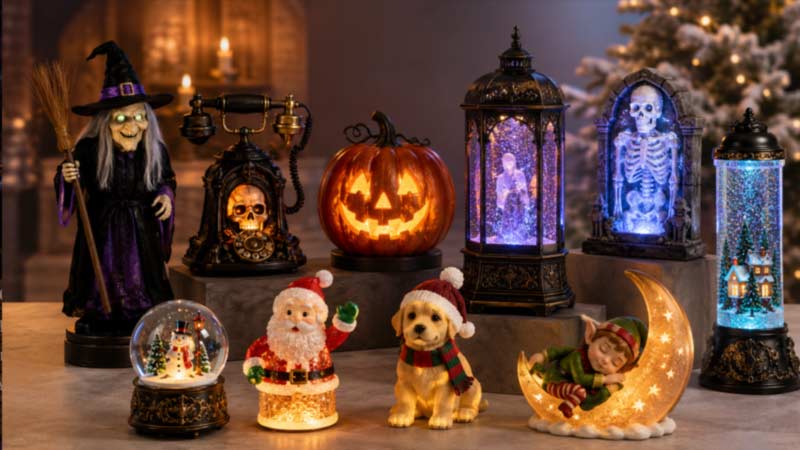
interactive holiday decorations wholesale
The market for interactive holiday decorations wholesale is expanding as retailers look for seasonal products that offer more than a static visual display.
LED lighting, music, rotating scenes, animated movement and motion sensors can transform familiar Christmas and Halloween characters into products that attract attention in stores and perform well in short promotional videos.
However, adding more functions does not automatically create a better decoration. A successful interactive product must still have an appealing design, a clear operating method and a structure that remains stable during transportation, retail demonstration and repeated consumer use.
This guide explains how retailers, importers, distributors and private-label brands can evaluate interactive seasonal decorations before beginning product development or bulk production.
Why Interactive Seasonal Decorations Are Growing
Traditional seasonal decorations mainly depend on character design, color and surface detail. Interactive decorations add movement, sound or lighting to create a more immediate customer response.
A Christmas lantern may begin glowing while glitter circulates inside the transparent chamber. A ballerina can rotate inside a musical water globe. A Halloween skeleton may turn its head, illuminate its eyes and speak when someone approaches.
These effects are especially useful in physical retail environments because customers can understand the main product feature within a few seconds. They are also suitable for ecommerce, where short videos can demonstrate movement and lighting more effectively than static photographs.
Interactive decorations can therefore serve two purposes. They can generate direct product sales, while also attracting attention to a wider seasonal collection.
For a broader view of the colors, materials and product styles influencing the market, read our Holiday Decor Trends 2026 report for Europe and North America .
The Function Should Support the Product Story
The strongest interactive decorations begin with a clear character or scene. Lighting, music and movement are then selected to support that concept.
For example, a haunted telephone can ring while its receiver moves. A witch can turn toward an approaching customer. A skeleton musician can move its mouth while sound plays. A Christmas ballerina can rotate slowly inside an illuminated water globe.
When the function matches the character, the product feels intentional. It also becomes easier to explain through packaging, product descriptions and short videos.
By contrast, adding unrelated functions can make the product feel complicated. A decoration does not need lighting, music, movement and sensors at the same time unless those features create one consistent experience.
During product development, buyers should first define what they want the customer to see, hear or feel when the decoration is activated. The mechanism can then be developed around that experience.
Lighted Holiday Decorations
Lighting is one of the most widely used interactive functions because it creates a visible effect without requiring a complicated mechanical system.
Warm white LEDs are commonly used in Christmas decorations because they create a traditional and welcoming atmosphere. They work well with Santa figures, gingerbread characters, lanterns, churches and winter village scenes.
Cool white or blue lighting can support silver, transparent and winter-inspired products. Amber light is suitable for pumpkins and vintage Halloween lanterns, while green, purple and red lighting can create a stronger effect for witches, monsters and gothic decorations.
The lighting should be evaluated in both bright and dark environments. A product may look impressive in a dark sample room but appear too weak under normal store lighting.
At the same time, the decoration should remain attractive when the light is switched off. Customers may display the product during the day, so lighting should enhance the design rather than hide a weak product structure.
Light diffusion also affects the final appearance. An LED placed too close to a thin plastic surface can create a bright spot, while a well-designed diffuser creates a softer and more consistent glow.
Additional Christmas lighting and material directions are discussed in 2026 Christmas Decor Trends for Retail Buyers .
Musical Christmas Decorations
Music can strengthen the emotional appeal of a Christmas decoration, particularly when it is connected with a familiar character or scene.
Musical water globes, Christmas churches, ballerina decorations and Santa figures often include several traditional holiday melodies. Buyers should confirm how the tracks are selected, whether the music repeats automatically and whether consumers can operate the lighting without activating the sound.
Separate music control is useful because not every customer wants continuous sound. A retailer may want the full music demonstration during a promotional event but prefer a silent lighting mode during normal opening hours.
Volume should also be tested in realistic environments. A sound level that seems acceptable during sample inspection may become distracting when several products are activated in the same store area.
The speaker position can influence both sound quality and product appearance. It should provide clear audio without creating large visible openings that weaken the design.
Mechanical noise must also be considered. When the music is switched off, the motor should not be loud enough to distract from the visual effect.
Rotating Water Globes and Glitter Lanterns
Water globes and glitter lanterns create movement through internal liquid circulation rather than external character animation.
When the product is activated, a small motor circulates the liquid and decorative particles. LED lighting then reflects from the moving glitter, creating an effect that can be understood immediately in a product video.
Some designs also include a rotating internal figure or miniature scene. This can increase visual depth, but the movement must remain smooth and stable after repeated use.
The quantity and size of the glitter require careful adjustment. Too much glitter can hide the central scene, while too little may make the product appear inactive.
The color of the liquid, light position, particle density and internal character should therefore be reviewed together. Changing one element may affect the complete visual result.
Buyers should also inspect liquid clarity and check whether small particles settle in unwanted areas. Internal decorative parts must remain securely fixed throughout transportation and operation.
Explore our wholesale LED glitter water lanterns and snow globes for Christmas, Halloween, wedding and all-season product development.
Animated Christmas Decorations
Christmas animation usually creates a softer and more relaxed experience than Halloween movement.
Santa figures may wave, move their mouths or turn their heads. Snowmen can sing and sway gently. Reindeer may move slowly while illuminated. Ballerinas and miniature winter scenes often use continuous rotation.
The speed of the movement should match the emotional tone of the product. Fast or abrupt motion may reduce the warm atmosphere expected from a traditional Christmas decoration.
In many cases, a slower movement combined with warm lighting produces a more premium effect than several dramatic functions operating at the same time.
Buyers should observe how the mechanism affects fabric, clothing and attached accessories. A moving arm may catch on a sleeve, while internal wires can become trapped if the structure is not planned carefully.
The decoration should therefore be tested as one complete product rather than as separate electrical and decorative components.
Halloween Animatronics and Motion Sensors
Halloween products can use faster and more surprising movements because suspense and customer reaction are part of the seasonal experience.
A sensor-activated witch may turn toward the customer. A skeleton can open its mouth while speaking. A tombstone figure may rise when movement is detected.
The activation distance must match the intended display environment. A sensor that is too sensitive may cause the product to operate continuously in a busy store. A sensor with a very short range may fail to demonstrate the product when customers walk past.
The sensor should be tested from different angles and under different lighting conditions. Buyers should also consider whether the product needs a manual demonstration button for stores where automatic activation is not practical.
Sound and movement should begin at the correct time. A noticeable delay can make the product feel less responsive, while poor synchronization may weaken the effect.
Repeated operation is especially important for retail display samples. A product that may be activated hundreds of times in a store requires more durability than a decoration used occasionally in a home.
For more Halloween product themes, continue to our Halloween Decor Trends 2026 retail guide .Retailers can also explore wholesale Halloween animatronic decorations with customizable lighting, sound, movement and sensor functions.
Choosing the Right Power System
The power system influences product placement, performance, packaging and consumer convenience.
Battery-powered decorations can be placed on tables, shelves and mantels without visible cables. They are also useful in store displays where access to a power outlet may be limited.
However, products combining strong lighting, music and continuous movement may consume batteries quickly. Buyers should test operating time with all main functions activated rather than relying only on the rated consumption of individual components.
USB power can provide more consistent performance for tabletop decorations intended to operate for longer periods. It is also convenient for ecommerce customers who already use USB adapters and power banks.
Dual-power products provide both battery and USB operation. This gives customers more flexibility, although the additional wiring, connectors and accessories may increase cost and packaging requirements.
Larger decorations may require adapter power to support stronger motors, louder speakers or continuous lighting. The final electrical specification should be confirmed according to the destination market and intended retail use.
Independent Controls Improve Product Usability
Interactive products are easier to use when their main functions can be controlled independently.
A water globe may allow customers to use the lighting and glitter movement without music. An animated character may offer a silent movement mode. A Halloween decoration may provide manual, sensor and off positions.
This flexibility allows one product to work in different environments. Some customers want a complete demonstration, while others prefer a quiet decorative light.
The control panel should be easy to reach but should not interrupt the front appearance of the product. Labels must also explain each operating mode clearly.
Confusing switches can create unnecessary customer complaints. Consumers may believe a product is defective when only one function has been selected.
The operating sequence should therefore be reviewed during packaging development, not only after the product design is complete.
Testing the Complete Interactive System
A motor, speaker, sensor and LED module may each work correctly when tested separately. The finished decoration must still be evaluated as one complete system.
Repeated activation can create vibration, heat and pressure on internal wires. Moving components may also affect decorative clothing, character limbs and attached accessories.
During testing, buyers should observe whether the movement becomes slower, whether the sound quality changes and whether decorative parts begin touching the mechanism.
For rotating products, the central scene should remain balanced throughout the complete movement. For animated characters, wires and fabric must remain clear of gears and moving joints.
Longer function testing can reveal problems that may not appear during a short sample demonstration. This is particularly important for products intended for continuous store display.
The sample approval process should record the final speed, sound, lighting level, sensor range and power mode. These details then provide a clearer standard for bulk production.
Packaging Interactive Holiday Decorations
Interactive decorations usually require more packaging protection than static figurines because shock and vibration can affect the internal mechanism.
The product should be held securely without placing pressure on moving parts. Character arms, heads, telephone receivers and other animated components may require individual protection.
Large decorations can use detachable structures to reduce carton dimensions. However, assembly should remain simple, and electrical connectors must be clearly marked.
The packaging should explain the required batteries or power connection, included accessories and available operating modes. It should also state whether the product is intended for indoor, covered outdoor or outdoor use.
When a product includes a try-me function, the demonstration structure should not damage the internal switch or consume excessive battery power before purchase.
Clear operating information reduces returns and makes it easier for retail staff to demonstrate the product correctly.
Presenting Interactive Products Online
A static photograph cannot fully explain a moving, musical or sensor-activated decoration.
The product page should combine clean product images with a short demonstration video. The main effect should appear near the beginning of the video instead of after a long introduction.
A white-background image shows the complete product structure, while a lifestyle image explains how the decoration may look in a home, store or outdoor display.
Close-up photographs should show the character details, material texture, control panel and lighting effect. A scale image can help customers understand whether the product is a small tabletop decoration or a larger display item.
When the product has several operating modes, the video should show each mode clearly. Customers should understand whether the music, lighting and movement operate together or independently.
The product title and description must also state the functions directly. Terms such as “lighted,” “musical,” “rotating,” “animated” and “motion activated” should only be used when they accurately describe the finished product.
Compliance Should Be Considered During Development
Compliance requirements depend on the final product structure, power system, materials, intended use and destination market.
For this reason, buyers should not wait until production is complete before discussing testing and documentation.
A battery-powered tabletop figurine may have different requirements from a plug-connected outdoor lighting product. Products intended for children’s environments may also require additional review.
The product development team should confirm the target market, power specification, material restrictions, battery access, warnings and labeling requirements before the final sample is approved.
Qualified testing laboratories can then determine which standards and test procedures apply to the finished product.
Planning compliance early can reduce the risk of redesigning the electrical structure, packaging or instruction manual after bulk production has already begun.
Building a Balanced Interactive Product Collection
A seasonal assortment does not need every product to include lighting, sound, movement and sensors.
Simple lighted products can provide accessible price points. Musical water globes and rotating decorations can form the main middle range. Larger animatronics can act as premium products and visual attractions.
This structure gives retailers several levels of interaction without making the complete assortment technically complex or expensive.
The functions should also reflect the holiday. Christmas collections generally benefit from warm lighting, familiar music and gentle movement. Halloween programs can use stronger sound, sudden motion and sensor activation.
Interactive decorations should coordinate visually with static figurines, wreaths, garlands and other products in the same collection.
A lighted Santa, for example, can share colors and materials with smaller Santa figurines and Christmas ornaments. An animated witch can coordinate with tabletop cauldrons, potion bottles and gothic lanterns.
This allows the interactive product to become part of a complete retail story rather than an isolated novelty item.
What Buyers Should Confirm Before Ordering
Before placing a bulk order, buyers should confirm exactly what happens when the product is activated.
The lighting, sound, movement and sensor behavior should be described clearly. Broad phrases such as “animated product” are not enough to establish a production standard.
The expected operating time, power requirements and included accessories should also be documented. When several operating modes are available, each switch position should be confirmed during sample approval.
For animated products, buyers should request repeated-cycle testing and listen to the noise produced by the mechanism. For water globes, they should check liquid clarity, glitter circulation, internal scene stability and leakage protection.
The final packaging should be reviewed together with the operating instructions. Consumers must be able to install the batteries, connect the power source and select the required function without difficulty.
Finally, testing responsibilities, inspection requirements and acceptable quality standards should be agreed before bulk production begins.
Frequently Asked Questions About Interactive Holiday Decorations
What are interactive holiday decorations?
Interactive holiday decorations use features such as LED lighting, music, rotation, animated movement, sound effects or motion sensors to create a more engaging seasonal display.
Which interactive functions are suitable for Christmas decorations?
Christmas products commonly use warm lighting, traditional music, gentle character movement, rotating scenes and swirling glitter effects.
Which functions are suitable for Halloween decorations?
Halloween decorations can use illuminated eyes, talking characters, moving heads, opening mouths, sudden movement, frightening sounds and motion-sensor activation.
Are battery-powered interactive decorations suitable for retail?
Yes. Battery power provides flexible placement, although buyers should test battery life when lighting, music and movement operate together.
What is a dual-power seasonal decoration?
A dual-power decoration can normally operate through batteries and a USB connection. This allows consumers to choose between portable placement and continuous external power.
Can interactive holiday decorations be customized?
Yes. Buyers can customize character designs, colors, materials, lighting, music, movement, sensor functions, power modes, packaging and branding.